
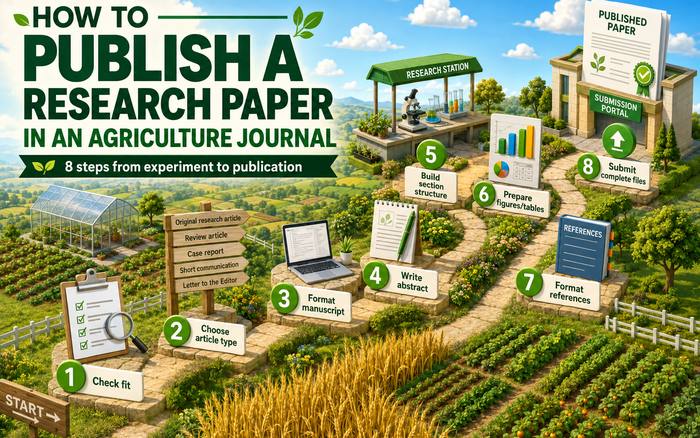
How to Publish a Research Paper in an Agriculture Journal
The eight steps from a finished experiment to a published, indexed paper — with this journal’s actual limits, formats and timelines, not generic advice.
Publishing a paper in an agriculture journal comes down to eight steps: confirm the journal fits your subject, pick the correct article type, format the manuscript to the journal’s specification, write the abstract within its word limit, build the standard section structure, prepare figures and tables to spec, format references in the required style, and submit the complete file set. Most rejections and delays happen at steps that cost nothing to get right.
Everything below is the specification for this agriculture journal, the International Journal of Agriculture and Food Science. Other agriculture journals differ in the details, but the sequence is the same everywhere.
Step 1. Confirm the journal actually fits your work
Before formatting anything, check that your subject sits inside the agriculture journal’s the journal’s aim and scope. A well-written paper sent to the wrong journal is rejected without review, and that is the single cheapest rejection to avoid.
While you are checking, look at three other things: which databases the journal is genuinely indexed in (our Indexing Information page lists every one with a direct verification link), what the charges are, and whether the review process is described openly. If a journal will not tell you these three things before submission, that is your answer.
Step 2. Choose the right article type
This journal accepts four types, and each has its own limit:
- Original research article — the standard full-length paper, up to 15 pages
- Review article — summarised, up-to-date information on a topic, not more than 4,500 words
- Case report — up to 2,000 words, up to 10 references, up to 6 authors
- Short communication — concise new findings or preliminary results
- Letter to the Editor — up to 800 words with 5–10 references, usually related to something already published in the journal
Picking the wrong type is a common cause of delay. A 4,000-word manuscript submitted as a short communication has to be reclassified before it can even go to review.
Step 3. Format the manuscript before you write, not after
The journal’s formatting requirements are specific and easy to satisfy if you set them up at the start:
- File format: MS Word (.doc or .docx)
- Font: Times New Roman, size 12, single line spacing
- Layout: one column, margins of one inch (2.5 cm) on all four sides
- Language: English
- Length: not more than 15 pages
The first page carries the title, all authors’ names, their affiliations, all authors’ e-mail addresses, and the complete address of the corresponding author with e-mail and phone number. Keep the title concise and informative — it is the part most readers and search engines see first.
Step 4. Write the abstract and keywords to the stated limits
The abstract must be no more than 300 words and must carry the gist of the entire study. Three rules are worth memorising, because they are the ones most often broken:
- No abbreviations in the abstract
- No references in the abstract
- No taxonomic authorities in the abstract
Follow the abstract with 3 to 6 keywords. Choose terms a reader would actually search for — the crop, the compound, the technique, the region — rather than words already present in your title.
Step 5. Build the standard section structure
The journal expects the conventional arrangement, and each section has a defined job:
- Introduction — the problem, the relevant earlier literature, and your proposed method or solution, with proper references
- Materials and Methods — experimental protocols, instruments, software and the study area, with references
- Results — clear and concise findings, written in the past tense, with no references
- Discussion — the significance of the results set against earlier work
- Conclusion — the important outcomes
- Acknowledgments — funding body, institutional head, co-workers, field assistants, and a declaration of any conflict of interest
Results, Discussion and Conclusion may be combined where that reads better. Note the tense rule in Results — past tense, no references — because reviewers flag it constantly.
Step 6. Prepare figures, tables and units correctly
Figures
Figures go in the Word file in JPG/JPEG format, at a width of 75 mm or 155 mm and a resolution of 300 dpi. Number them in the order they are cited. Multi-part figures are marked A, B, C. Put all figure legends on a separate page.
Tables
Keep tables simple: a few horizontal lines, no vertical lines. Place all tables after the references, numbered in Arabic numerals with a self-descriptive heading. Build them with Word’s table tools, not with spaces or tabs. Never present the same data in both a table and a graph.
Units
Use SI units. A space goes between the number and the symbol (10 mg, not 10mg); symbols are never pluralised and take no full stop; and a zero goes before a decimal point (0.01). Genus and species names are italicised. Use an en dash for ranges (10–25) and the multiplication sign × rather than the letter x.
Step 7. Format references in Vancouver style
References are numbered in the order they appear in the text and formatted in Vancouver style. For a journal article with up to six authors, all authors are listed; with seven or more, list the first six followed by et al.
Al-Habian A, Harikumar PE, Stocker CJ, Langlands K, Selway JL. Histochemical and immunohistochemical evaluation of mouse skin histology. J Histotechnol. 2014 Dec;37(4):115-124.
The Instructions to Author page gives 22 worked examples covering books, chapters, electronic articles, reports, web pages, theses and conference posters. Reference formatting is worth doing with a manager such as Zotero or Mendeley set to a Vancouver style, then checked by hand.
Step 8. Submit the complete set of files
Submission is not just the manuscript. Three documents go together:
- A cover letter stating the work is original, not published before and not under consideration elsewhere, sent by the corresponding author on behalf of the co-authors. You may optionally suggest two potential reviewers with their contact details and affiliations.
- A signed authorship responsibility form
- The complete manuscript, with all figures and all tables carrying headings and legends
Sample files for all three are downloadable from the Instructions to Author page. Submit through the manuscript submission link or by e-mail to the Managing Editor.
What Happens After You Submit
At this agriculture journal the manuscript goes first to the subject editor, who checks it against editorial policy and a minimum quality level. If it passes, it is sent to two reviewers for double-blind peer review — all identifying information is stripped from the document, so the reviewers do not know who wrote it and you do not know who reviewed it.
Reviewer comments are made anonymous and sent to the corresponding author. You are expected to return the revised manuscript within one week. The revision goes back to the reviewers, and the Subject Editor takes the final decision. Where substantial revisions are requested, acceptance depends on whether you have dealt with them satisfactorily.
Accepted papers come back to you in ready-to-print format for proofreading. Read that proof carefully — once the article is published, no changes are made. Articles appear online and in print, and a download link is e-mailed to the author. The full policy is on the Peer Review and Publication Policy page.
Charges, Licence and Reuse
There is no submission fee. An article handling and processing charge is payable only after the manuscript has passed peer review and been accepted:
- Indian authors — 2,500 INR (w.e.f. 01.10.2022)
- International authors — 55 USD (w.e.f. 01.10.2022)
The charge covers manuscript formatting, the publication process and website maintenance; the journal receives no governmental or non-governmental financial support. Published articles are free to read immediately, with no subscription or registration, under a CC BY-NC 4.0 licence. You keep the copyright to your own work, and you may deposit it in your institutional repository.
Five Things That Slow Papers Down
- Scope mismatch. The commonest desk rejection, and entirely avoidable.
- An abstract over 300 words, or one containing abbreviations and references. It gets sent back before review.
- References in a mixed or wrong style. Vancouver, numbered in order of citation — check it before submitting, not after.
- Low-resolution figures. Screenshots and 72 dpi images cannot be printed at 300 dpi; the original file is needed.
- Text overlap. Every paper is screened by Similarity Check. Paraphrasing your own earlier paper still registers — cite it instead.
Frequently Asked Questions
How much does it cost to publish in this journal?
There is no article submission fee. An article handling and processing charge applies only after a manuscript has passed peer review and been accepted: 2,500 INR for Indian authors and 55 USD for international authors, in effect since 1 October 2022.
How long does the review take?
The editor carries out an initial check, then sends the paper to two reviewers for double-blind review. Reviewer comments are passed to the corresponding author, who is asked to return the revised manuscript within one week. The revision goes back to the reviewers, and the Subject Editor takes the final decision.
Will my paper be checked for plagiarism?
Yes. Every submitted paper is screened using Similarity Check by Crossref. Authors found guilty of plagiarism are debarred from publishing in the journal for six months, and a paper found to be plagiarised after publication is retracted.
Do I lose copyright when my paper is published?
No. Authors retain ownership of the copyright of their own work. Articles are published under the Creative Commons Attribution-NonCommercial (CC BY-NC) 4.0 licence, and the journal does not require a copyright transfer.
Can I put my paper in my university repository?
Yes. The journal permits authors to deposit versions of their work in an institutional or other repository of their choice, in line with the Sherpa/Romeo Green policy.
What is the word limit for a review article?
A review article should not be more than 4,500 words. Original research articles should not exceed 15 pages, case reports 2,000 words, and letters to the editor 800 words.
Editorial note
Limits, charges and process described here are those published on this journal’s Instructions to Author and Publication Policy pages. Charges are those in effect from 1 October 2022; authors should confirm current figures before submitting. See also our guide to NAAS ratings and how agriculture journals are scored.