
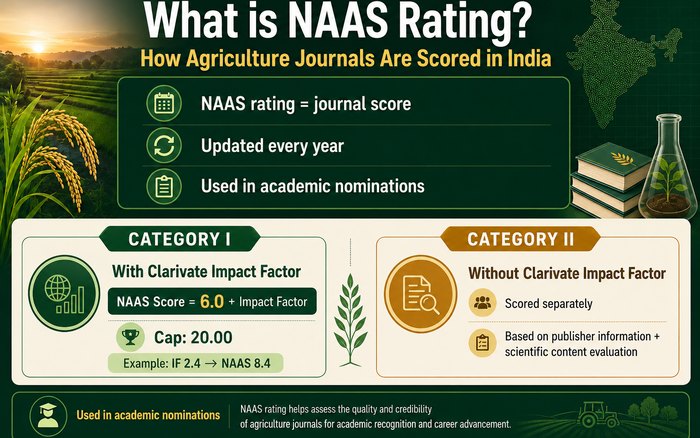
What is NAAS Rating? How Agriculture Journals Are Scored in India
A short, accurate guide to the National Academy of Agricultural Sciences journal score — how it is calculated, what the two categories actually mean, and how it is used in academic nominations.
The NAAS rating is a score assigned to agricultural and allied-science journals by the National Academy of Agricultural Sciences, New Delhi. Journals that carry a Clarivate Impact Factor are scored by the formula 6.0 + Impact Factor, capped at 20.00. Journals without a Clarivate Impact Factor are scored separately, on the basis of information supplied by the publisher and an evaluation of the journal’s scientific content. The list is revised every year.
What NAAS Is
The National Academy of Agricultural Sciences is an Indian academy working on agricultural research and policy. It organises its work through eight scientific sections covering crop sciences, horticulture, animal sciences, fisheries, natural resource management, plant protection, agricultural engineering and agricultural social sciences.
Alongside its academic work, NAAS maintains a scored list of agriculture journals publishing in agriculture and allied sciences. That score is what authors refer to as the “NAAS rating”.
How the NAAS Score Is Calculated
This is the part of agriculture journal scoring most often described incorrectly. NAAS divides journals into two categories, and the split is not based on the score itself — it is based on whether the journal has a Clarivate Impact Factor.
Category I — journals with a Clarivate Impact Factor
For these journals the score is arithmetic:
NAAS Score = 6.0 + Impact Factor, with capping at 20.00
Because of the 6.0 base, every Category I journal scores at least 6.0. A journal with an Impact Factor of 2.4, for example, receives a NAAS score of 8.4.
Category II — journals without a Clarivate Impact Factor
These journals are scored, in the Academy’s own words, “on the basis of information provided by the Publishers in a prescribed proforma and also evaluation of scientific contents”. There is no public formula; it is an assessment.
This distinction matters when authors compare journals. A Category II score of 4.9 and a Category I score of 7.2 were not produced by the same method, and treating them as points on one scale is misleading.
How NAAS Scores Are Actually Used
The Academy uses the scores in its own Fellowship and Associateship nominations, and the rules are specific:
- Fellowship — the total NAAS score of the candidate’s 40 most important publications is multiplied by 0.125, capped at 50 marks.
- Associateship — the total for the 20 most important publications is multiplied by 0.3, capped at 60 marks.
- Reviews carry no marks. Only original research publications count.
- Author position matters. The first author and the corresponding author receive full marks; co-authors receive 75%.
Two practical consequences follow. First, a long list of review articles adds nothing to a NAAS nomination. Second, where you sit in the author order changes what a paper is worth to you — which is worth settling with your co-authors before submission, not after.
How to Check a Journal’s NAAS Score Yourself
Agriculture journal scores are published by NAAS as a downloadable list on naas.org.in. Two habits are worth forming:
- Always check the year. Scores are revised annually, so “NAAS 6.2” without a year is incomplete. Cite it as, for example, “NAAS (2026): 6.2”.
- Verify on the NAAS list, not on the journal’s website. A score printed on a publisher’s own page is a claim until you have matched it against the official list.
What the NAAS Score Does Not Tell You
A NAAS score measures what the Academy set out to measure for an agriculture journal, and nothing more. It is not a statement about a specific article, and a high score does not guarantee that any individual paper in that journal is sound. Nor is it a substitute for the checks that actually protect an author:
- Whether the journal runs genuine peer review, and how long it takes
- Which databases actually index it — check the links yourself rather than trusting a logo
- Whether articles receive a registered DOI, so they remain citable and permanently linkable
- What the charges are, and whether they are stated openly before submission
- Whether the editorial board is real, named, and contactable
Be particularly careful with journals advertising an “impact factor” from a body you cannot identify. The Clarivate Journal Impact Factor is a specific, verifiable metric; unrelated numbers with similar names are not the same thing, and NAAS itself only recognises the Clarivate figure in its Category I formula.
How NAAS scores are used in practice
The Academy applies the scores in its own Fellowship and Associateship nominations, and the arithmetic is public. But authors meet NAAS scores in a wider set of places, and it is worth being clear about which uses are documented and which are convention.
| Use | Basis |
|---|---|
| NAAS Fellowship nomination | Total NAAS score of the 40 most important publications × 0.125, capped at 50 marks |
| NAAS Associateship nomination | Total for the 20 most important publications × 0.3, capped at 60 marks |
| Institutional assessment | Varies by institution — ask yours rather than assume |
| Choosing where to submit | Author judgement; no rule requires it |
Two details in the first two rows change what a publication is worth to you. Reviews and review articles carry no marks at all, so a long list of them adds nothing to a NAAS nomination. And the first author and the corresponding author receive full marks while co-authors receive 75%, which is worth settling with your co-authors before submission rather than after.
Checking a score without being misled
Three habits prevent the errors that circulate about agriculture journal scores:
- Cite the year. The list is revised annually, so “NAAS 6.2” without a year is incomplete. Write it as “NAAS (2026): 6.2”.
- Check the official list, not the journal’s page. A score printed on a publisher’s own site is a claim until you have matched it against naas.org.in.
- Do not compare across categories. A Category II score and a Category I score were produced by different methods, so ranking them on one scale is meaningless.
That third point is where most confusion starts, and it is worth repeating because so many third-party pages get it wrong: the categories are defined by whether the journal has a Clarivate Impact Factor, not by the score itself.
Where This Journal Stands
The International Journal of Agriculture and Food Science (P-ISSN 2664-844X, E-ISSN 2664-8458) carries a NAAS rating of 4.97 for 2026. It is a Category II journal — scored on the evaluation route rather than the Impact Factor formula — which is the position of most Indian agricultural journals that are not indexed in the Clarivate database.
Alongside that, the journal operates double-blind peer review with two independent reviewers, registers every published article with a Crossref DOI, and lists every database it is indexed in, with direct verification links, on the Indexing and Abstracting page. Authors are encouraged to follow those links rather than take the list on trust.
Frequently Asked Questions
What is a good NAAS score for an agriculture journal?
There is no single threshold that makes a score “good”. Because Category I journals start at 6.0 by formula, any journal carrying a Clarivate Impact Factor will score above 6.0, while Category II journals are scored on content evaluation and typically sit lower. Comparing a Category II score directly against a Category I score is not a like-for-like comparison.
How often is the NAAS journal list updated?
NAAS revises the list annually and invites publishers to submit a Journal Evaluation Proforma for the coming year. A journal’s score can rise, fall or stay the same between editions, so always cite the year along with the score.
Do review articles count for NAAS marks?
No. In NAAS Fellowship and Associateship nominations, reviews and review articles receive no marks. Only original research publications are counted.
Do co-authors get the same NAAS marks as the first author?
No. The first author and the corresponding author receive full marks, while co-authors receive 75% of the marks.
Where can I verify a journal’s NAAS score?
Only on the official NAAS website, naas.org.in, which publishes the scored journal list as a downloadable document. Any score quoted on a publisher’s own website should be checked against that list.
How is the NAAS score calculated for a journal with an Impact Factor?
For Category I journals — those with a Clarivate Impact Factor — the NAAS score is 6.0 plus the Impact Factor, capped at 20.00. A journal with an Impact Factor of 2.4 therefore receives a NAAS score of 8.4.
Editorial note
Scoring rules described here are taken from the National Academy of Agricultural Sciences’ own published criteria. NAAS revises its journal list annually; authors should confirm any current score against the official list at naas.org.in before citing it.