
- Printed Journal
- Indexed Journal
- Refereed Journal
- Peer Reviewed Journal


P-ISSN: 2664-844X
E-ISSN: 2664-8458
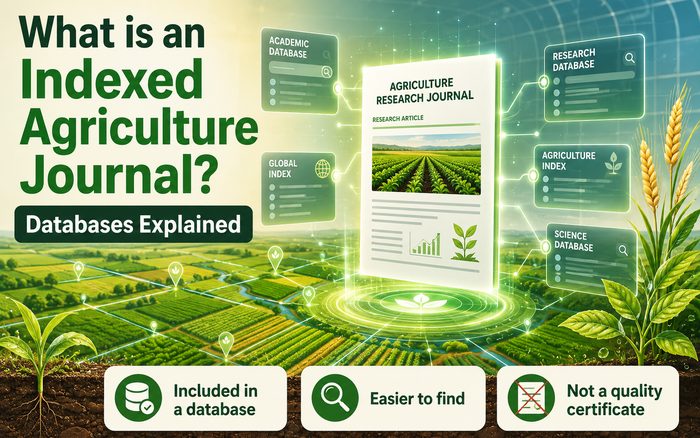
An indexed agriculture journal is one that has been included in a database, so its articles appear when someone searches that database rather than only on the journal’s own website. Indexing is about being found. It is not a quality certificate, and every claim can and should be verified in the database itself.
Indexing is the claim authors are least equipped to check and the one most often inflated. Fifteen minutes settles it for any journal.
Your article lives on the agriculture journal’s own website. Without indexing, someone finds it only if they search the journal directly or stumble on it through a general search engine.
When a database indexes the journal, your article’s metadata — title, authors, abstract, keywords, DOI — enters that database. Now anyone searching for your topic in that system finds you, whether or not they have heard of the journal. That is the entire mechanism, and it is why the keywords you choose matter more than most authors think.
A row of database logos on a journal homepage is an image file. Nothing prevents anyone from putting one there.
The check is to leave the journal’s website and go to the database:
That second failure catches careful people. A journal indexed in 2020 and dropped in 2023 may still display the logo, and nothing on the page tells you. This is why our Indexing Information page gives a direct link for every entry rather than a badge — you can check each one without asking us.
| Type | What it does | Selective? |
|---|---|---|
| Citation index | Tracks citations between articles; used for metrics | Highly |
| Abstract database | Collects metadata for searching | Selective |
| Subject database | Covers one field in depth | Selective within its field |
| Aggregator / discovery | Harvests metadata broadly | Usually not |
| Search engine | Crawls scholarly content | No inclusion criteria |
The last two rows explain a common confusion. Being findable in a scholarly search engine is useful, but it is not the same as being selected into a curated database, because nothing was assessed. Institutions generally treat the two differently, and it is worth knowing which yours counts.
There is no universal list, and anyone presenting one is guessing at your situation. What matters depends on three things:
That third point gets overlooked. Indexing exists to connect your paper with readers; a database nobody in your area searches connects you with nobody.
Databases do not read your PDF. They read the metadata the publisher deposits — title, authors, affiliations, abstract, keywords, DOI, references. If that deposit is thin or wrong, your paper is indexed thinly or wrongly, whatever the journal’s list looks like.
This is a practical reason to care whether a journal registers DOIs with Crossref. That deposit is the metadata record, and it is what most downstream systems harvest. A journal that does not deposit has nothing for databases to pick up.
Two things you control: keep your author name consistent across all your papers, and give your keywords real thought. Both feed the record that makes your work findable.
Getting into a major database takes years and involves an application, an assessment period and continued compliance. A journal that began recently will have a shorter list than one running since the 1970s, and that difference is about age rather than rigour.
So do not use list length as your test. Use the checks that describe how the journal operates now — is the review process described, does every article carry a DOI, are charges stated before submission, is the archive complete. Our guide on what makes a good agriculture journal works through all nine.
Authors in Indian agricultural research meet three separate lists and often treat them as one. They are not, and knowing which is which saves a good deal of confusion:
| What it is | Who maintains it | |
|---|---|---|
| Indexing | Databases that carry the journal’s articles | Each database, independently |
| NAAS score | A rating assigned to journals in agriculture and allied sciences | National Academy of Agricultural Sciences |
| Institutional list | Journals your university or institute counts for assessment | Your own institution |
A journal can appear on one and not the others. The list that decides whether your publication counts for a promotion is the third one, and it is the only one your journal cannot tell you about — ask your own office before you submit. Our guide on what a NAAS rating is covers the second.
If the three databases you care about check out, the rest of the list is a bonus. If none do, the length of the list is irrelevant.
Newly published articles do not enter databases the same day. Each system harvests on its own schedule and a lag of weeks is normal.
Your paper is published and citable from the moment it appears online with its DOI — that is the fact that matters if a form or a deadline needs proof. Give the DOI. If a specific database still shows nothing after a couple of months while other articles from the same issue are there, raise it with the journal, because that usually means a metadata problem with your record specifically.
That a database has included the journal in its collection, so its articles appear when someone searches that database. Indexing is what makes a paper findable beyond the journal's own website.
Go to the database itself and search for the journal by name or ISSN. A logo on a journal homepage is an image file and proves nothing — including when the journal was once indexed and has since been dropped.
It depends on your sub-field and what your institution recognises. Ask what your university or funder counts before assuming; the list that matters to you may be shorter than you think.
No. Indexing is about discoverability; peer review is about quality control. A journal can be indexed somewhere and still run weak review, and a rigorous new journal may not be indexed anywhere yet.
Years, in the larger databases, and it involves an application and an assessment. This is why young journals often have short indexing lists — a fact about their age, not necessarily about their quality.
Databases harvest on their own schedules and a lag of weeks is normal. Your article is published and citable from the day it appears online with its DOI.
Related reading:
Created by Priyanka Bhatt • 10 Aug 2026
P-ISSN: 2664-844X
E-ISSN: 2664-8458

International Journal of Agriculture and Food Science