
- Printed Journal
- Indexed Journal
- Refereed Journal
- Peer Reviewed Journal


P-ISSN: 2664-844X
E-ISSN: 2664-8458

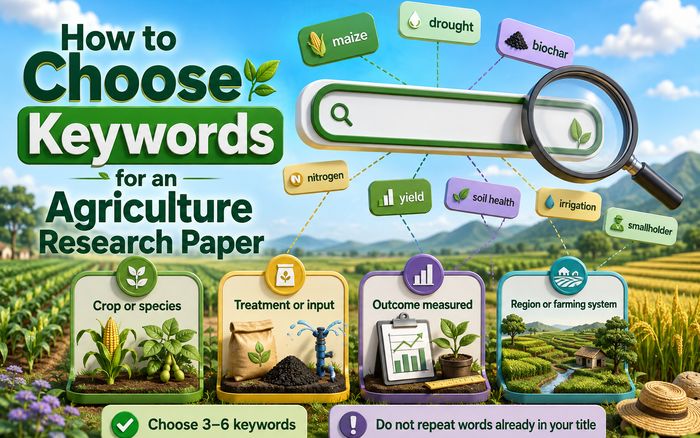
Choose 3 to 6 keywords covering the four things a reader searches on — the crop or species, the treatment or input, the outcome measured, and the region or farming system — and never repeat words already in your title. Keywords are how people who have never heard of your paper find it, and most authors spend thirty seconds on them.
This is the cheapest part of an agriculture journal manuscript to get right and one of the easiest to waste. A paper with generic keywords competes with millions of records; the same paper with specific ones reaches the handful of people who needed it.
Two systems read your agriculture journal keywords and use them differently:
Almost every useful agriculture journal keyword set covers these four. Pick one or two from each:
| Axis | Question it answers | Examples |
|---|---|---|
| Crop or species | What was studied? | wheat, Triticum aestivum, buffalo, Trichoderma |
| Treatment or input | What was applied or varied? | biochar, split nitrogen application, drip fertigation, seed priming |
| Outcome measured | What was recorded? | grain yield, nitrogen use efficiency, shelf life, soil organic carbon |
| System or region | Where does it apply? | rainfed, Indo-Gangetic plain, semi-arid Vertisol, protected cultivation |
A paper titled “Effect of nitrogen levels on grain yield of wheat under irrigated conditions” already contains the crop, the treatment and the outcome. So the keywords should spend their slots elsewhere: Triticum aestivum, nitrogen use efficiency, split application, Indo-Gangetic plain, apparent nitrogen recovery.
Repeating the title. It is the commonest waste, and it happens because the title words are the ones already in your head.
Title: Effect of biochar on soil properties and maize yield in a sandy loam
Keywords: biochar, soil properties, maize, yield — four slots, zero new information.
Better: Zea mays, soil organic carbon, cation exchange capacity, water holding capacity, rainfed agriculture. Now the paper is findable by five routes it was invisible on before.
This matters more in an agriculture journal than in most fields. A reader searching for Trichoderma harzianum and a reader searching for “biocontrol agent” are looking for the same paper and will not find each other’s terms.
Where the scientific name is central to the paper, include it. Where a common name is what practitioners use, include that too. You have three to six slots — spending two on the same organism in two forms is often the right call.
| Too broad | Better | Why |
|---|---|---|
| agriculture | conservation agriculture | The first matches everything and distinguishes nothing |
| soil | soil organic carbon | Names what you actually measured |
| yield | apparent nitrogen recovery | A searcher looking for this will not find “yield” |
| fertiliser | nano urea | One extra word, a far smaller and more relevant pool |
| pest management | integrated pest management | The established term people search for |
The instinct behind broad agriculture journal keywords is understandable — you want the widest audience. It backfires. Ranking for “soil” is impossible; being the clearest result for “biochar effect on cation exchange capacity in sandy loam” is achievable, and those are the readers who will cite you.
Take a realistic paper and choose its keywords properly. The study: a two-season field trial testing whether split nitrogen application improves nitrogen use efficiency in irrigated wheat on a sandy loam in Punjab.
Effect of split nitrogen application on grain yield and nitrogen use efficiency of irrigated wheat
Split nitrogen application, grain yield, nitrogen use efficiency, wheat. All four are indexed already. None should be a keyword.
| Axis | Keyword chosen | Why it is not in the title |
|---|---|---|
| Crop | Triticum aestivum | A reader searching the scientific name |
| Treatment | boot stage topdressing | The specific timing tested, never named in the title |
| Outcome | apparent nitrogen recovery | A second measure reported in the paper |
| System | Indo-Gangetic plain | Who needs this result |
| Extra | sandy loam | The soil type the finding is bounded by |
Five keywords, five new routes to the paper, zero overlap with the title. That took four minutes.
The four axes assume a field or laboratory study. Two other types need a different approach:
If the paper is already written, run this before you submit:
Most manuscripts fail step 1 and step 3. Fixing just those two is the whole exercise.
Good keywords make a findable paper more findable. They do not rescue a paper nobody wants, they do not compensate for a vague title, and they will not hold a reader whose attention the abstract loses.
Keywords go immediately after the abstract, before the introduction, and there should be 3 to 6. Practical points:
The full specification, along with the 300-word abstract limit, is on the Instructions to Author page. Our guide on writing an abstract covers how the two work together.
Between 3 and 6 at this journal, placed immediately after the abstract. Fewer than three wastes the field; more than six dilutes it, and some indexing systems truncate the list.
No. Search systems index the title already. Every keyword repeating a title word is a slot thrown away.
Yes, and it usually should be. Multi-word phrases such as nitrogen use efficiency match how people actually search far better than a single generic word.
Yes, where the paper is about a specific species — and include the common name too. Different readers search for different forms, and both should lead to your paper.
Indirectly. The keyword field is used by indexing databases; Google reads your title, abstract and full text. Choosing terms your readers actually use helps in both places, because you naturally repeat them in the text.
Immediately after the abstract, before the introduction, separated by commas. This journal asks for 3 to 6.
How to present and support the numbers:
Created by Manish Yadav • 09 Aug 2026
P-ISSN: 2664-844X
E-ISSN: 2664-8458

International Journal of Agriculture and Food Science