What is a DOI? A Plain Guide for Research Authors
What the number means, how to read it, why it keeps working when a web link stops — and the one thing a DOI does not tell you.
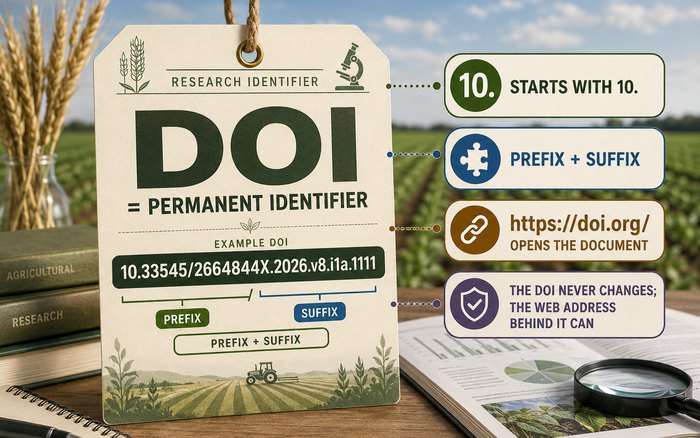
A DOI (Digital Object Identifier) is a permanent identifier assigned to a document, so that it can be found even if its web address changes. It always begins with 10. followed by a publisher prefix, a slash, and a suffix chosen by the publisher. Putting https://doi.org/ in front of a DOI opens the document at whatever address it currently lives. The DOI never changes; the address behind it can.
How to Read a DOI
Every agriculture journal DOI has exactly two parts, separated by a slash. Here is a real one from this journal:
10.33545 / 2664844X.2026.v8.i1a.1111 | Part | Value | What it is |
|---|---|---|
| Prefix | 10.33545 | Always starts with 10. — the rest identifies the publisher, assigned by the registration agency |
| Suffix | 2664844X.2026.v8.i1a.1111 | Chosen by the publisher and unique within that prefix |
The suffix carries no meaning that a machine relies on — it can be any string the publisher likes — but many publishers make it readable. This journal’s suffix is built from information you already know:
- 2664844X — the journal’s P-ISSN, 2664-844X, with the hyphen removed
- 2026 — year of publication
- v8 — volume 8
- i1a — issue 1, part a
- 1111 — the article number
So a DOI from this journal can be read at a glance. That is a convenience, not a rule — never assume a DOI from another publisher is structured the same way.
How to Use One
Prefix the DOI with the resolver address and open it:
https://doi.org/10.33545/2664844X.2026.v8.i1a.1111 The resolver looks up where that document currently sits and redirects you there. This is the correct way to link to a paper in a reference list, an e-mail, a thesis or a grant report — it will still work years later, when the publisher’s own URLs have changed.
Link to the DOI, not to the page you happen to be looking at. A copied browser address is a snapshot of today’s site structure. A DOI is a promise to keep working after that structure changes.
Why DOIs Exist: Link Rot
Web addresses decay, and agriculture journal archives are no exception. Journals redesign their sites, move to new platforms, change domains, get bought, or reorganise their archives. Every one of those events breaks the plain URLs that people pasted into their reference lists — and a citation that leads nowhere is a citation that cannot be checked.
A DOI solves this by adding one layer of indirection. The identifier is fixed and public; the address it maps to is a record the publisher maintains. When the article moves, the publisher updates the record, and every reference list in the world that used the DOI keeps working without anyone touching it.
This is why journals, funders, universities and databases increasingly treat a registered DOI as a basic requirement rather than a bonus.
Who Runs the System
- The DOI system is an international standard, ISO 26324, administered by the International DOI Foundation.
- Publishers do not register DOIs directly with the Foundation. They work through a registration agency.
- For scholarly articles the main agency is Crossref, a membership organisation of publishers. Crossref holds the metadata — title, authors, journal, year, references — alongside the identifier.
- Because that metadata is deposited centrally, Crossref also powers services built on top of it, including Similarity Check, the plagiarism screening this journal uses on every submission, and Cited-by, which reports which later papers cite yours.
This is worth knowing because it explains a common misunderstanding: DOI registration is a paid membership activity, not something that happens automatically when an article goes online. A publisher that does not join and does not deposit has no DOIs to give.
What a DOI Does Not Tell You
A DOI is an identifier, not a quality mark, and no agriculture journal should imply otherwise. It certifies nothing about the work it points to.
- It is not evidence of peer review. Preprints, datasets, technical reports and conference abstracts all carry DOIs, and none of them are peer reviewed by virtue of having one.
- It is not evidence of indexing. A journal can register DOIs and still not be indexed anywhere you care about. Check the databases directly.
- It is not a citation count, a ranking or an impact measure.
Treat an agriculture journal DOI as a minimum, not a recommendation. Its absence is a genuine warning sign; its presence simply means the publisher did one thing properly. The things that actually indicate quality — a described peer review process, plagiarism screening, and indexing you can verify yourself — have to be checked separately.
DOIs at This Journal
The International Journal of Agriculture and Food Science registers every published article with a Crossref DOI under the prefix 10.33545. The article remains permanently citable and permanently linkable, and every submission is screened through Crossref’s Similarity Check before it reaches a reviewer.
Articles are also free to read from the day they are published, so a DOI from this journal resolves to a full text that anyone can open — not to a paywall. Electronic content is stored on three separate sources, and all articles are additionally kept in printed form.
Citing a DOI in Vancouver Style
This journal uses Vancouver referencing. The DOI goes at the end of the reference:
Aho M, Irshad B, Ackerman SJ, Lewis M, Leddy R, Pope T, et al. Correlation of sonographic features of invasive ductal mammary carcinoma with age, tumor grade, and hormone-receptor status. J Clin Ultrasound. 2013 Jan;41(1):10-7. DOI: 10.1002/jcu.21990
Two habits worth keeping:
- Copy the DOI, never retype it. Suffixes mix letters and digits — the capital X in 2664844X, a lowercase i next to a 1 — and a single wrong character makes the reference unresolvable.
- Test every DOI before you submit. Paste each one after https://doi.org/ and confirm it opens the paper you meant. This takes a minute and catches errors that reviewers will otherwise catch for you.
When a DOI Will Not Open
If a DOI returns an error rather than an article, there are three ordinary explanations, in order of likelihood:
- A typo. By far the commonest cause. Re-copy it from the source.
- It has not been registered yet. A publisher may print a DOI on an article before depositing it with Crossref. Until the deposit is made, the resolver has nothing to point to, and newly published articles can take a short while to appear.
- The publisher’s link record is stale. If the article moved and the record was not updated, the DOI resolves to a dead address. This is a fault the publisher can fix — report it to the journal.
A DOI that has never worked is different from one that has stopped working, and it is worth telling the journal which you are seeing.
Frequently Asked Questions
What does DOI stand for?
DOI stands for Digital Object Identifier. It is a permanent identifier assigned to a document, defined by the international standard ISO 26324 and administered by the International DOI Foundation. For research articles the registration agency is usually Crossref.
Does every published article have a DOI?
No. A DOI has to be registered and paid for by the publisher, so it is a choice, not an automatic property of publication. Every article published in the International Journal of Agriculture and Food Science is registered with a Crossref DOI.
Does a DOI mean the article is peer reviewed?
No. A DOI identifies a document; it says nothing about how that document was reviewed. Datasets, preprints, reports and conference papers all carry DOIs. Judge quality by the journal's review process, plagiarism screening and verifiable indexing, not by the presence of a DOI.
How do I open an article from its DOI?
Put https://doi.org/ in front of the DOI and open it in a browser. For example, https://doi.org/10.33545/2664844X.2026.v8.i1a.1111 redirects to the article's current page on the publisher's site.
What should I do if a DOI does not resolve?
A DOI that returns an error usually means it has not been registered yet, or that it has been mistyped. Newly published articles can take a short time to appear in the resolver. Check the characters carefully — DOI suffixes often mix letters and digits — and if it still fails, contact the journal.
Can a DOI ever change?
The DOI itself does not change once assigned. What changes is the web address it points to; the publisher updates that link, so the DOI keeps working even after a site is redesigned or moved.
Editorial note
The example DOI is a live record from this journal and resolves to the published article. Referencing style follows this journal’s Instructions to Author. See also our guides to open access and subscription publishing and publishing a research paper in an agriculture journal.