Open Access vs Subscription: What Agriculture Authors Need to Know
Who pays, who can read it, what licence you grant, and what you keep — the four questions that actually separate the two models.
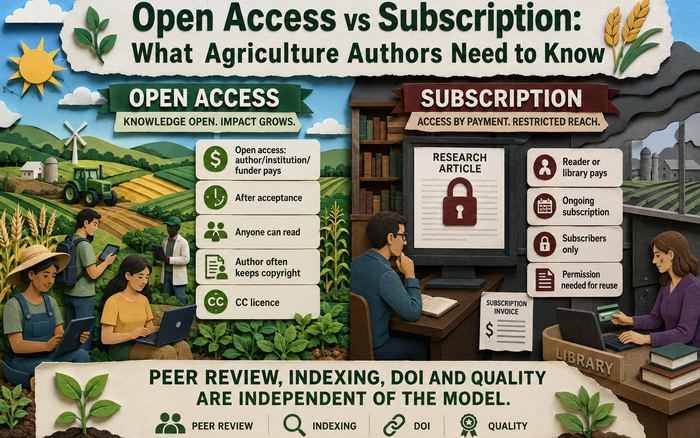
The difference between open access and subscription publishing is who pays and when. In a subscription journal the reader (usually their library) pays to read, and the author normally pays nothing. In an open access journal the article is free to read from the day it appears, and the cost is met by the author, their institution or a funder, usually as a charge after acceptance. Everything else — peer review, indexing, DOIs, quality — is independent of which model a journal uses.
The Two Models Side by Side
| Open access | Subscription | |
|---|---|---|
| Who pays | Author, institution or funder | Reader or their library |
| When | After acceptance | Ongoing, per subscription |
| Who can read it | Anyone, immediately | Subscribers only, often after an embargo for others |
| Copyright | Usually retained by the author | Often transferred to the publisher |
| Reuse | Governed by a Creative Commons licence | Permission needed from the publisher |
| Reach | No barrier for extension workers, farmers’ organisations, small institutions | Limited to institutions that can afford access |
That last row matters more for an agriculture journal than for most disciplines. A great deal of agricultural research is used by people outside universities — state extension services, cooperatives, NGOs, agri-input advisers, and farmers’ own organisations. None of them hold journal subscriptions. A paywalled paper on a regional pest outbreak reaches the researchers studying it and almost nobody who has to act on it.
What “Open Access” Actually Means
For an agriculture journal, open access is a statement about the reader, not about the author’s wallet. It means the article is:
- free to read and download from the moment of publication
- available with no subscription charge
- available with no registration or login
- reusable under a stated licence, so readers know in advance what they may do with it
All of these apply to this journal — the full terms are on the Open Access Policy page. What open access does not mean is that publishing is free. The costs of formatting, the publication process and hosting still exist; they are simply paid from a different direction.
Who Pays, and When
At the International Journal of Agriculture and Food Science the arrangement is stated openly:
- No article submission fee. Submitting costs nothing.
- An article handling and processing charge is payable only after the manuscript has passed peer review and been accepted.
- Indian authors: 2,500 INR. International authors: 55 USD. Both in effect from 1 October 2022.
The reason for the charge is also stated: the journal receives no governmental or non-governmental financial support, and the fee covers manuscript formatting, the publication process and website maintenance.
The sequence matters. A charge that falls after peer review cannot influence the review decision. A journal that asks for money before review, or that will not tell you the amount until after acceptance, is telling you something about how its review works.
The Licence Is the Part Most Authors Skip
Two agriculture journals can both be fully open access and still give readers very different rights. The licence is what decides that, and there are two you will meet most often:
| CC BY 4.0 | CC BY-NC 4.0 | |
|---|---|---|
| Share the article | Yes | Yes |
| Adapt and build on it | Yes | Yes |
| Credit required | Yes | Yes |
| Commercial use | Allowed | Not allowed without permission |
This journal applies Creative Commons Attribution-NonCommercial (CC BY-NC) 4.0. Anyone may download, reuse, reprint, modify, distribute and copy the work for non-commercial purposes, provided the original authors and source are cited. Commercial reuse is not covered by the licence: it needs prior permission from the journal, and charges apply. The exact terms are set out in the content licensing policy.
Check your funder’s conditions before you choose a journal. Some research funders and institutions require a specific licence — several mandate CC BY in particular — as a condition of the grant. That requirement, if it applies to you, narrows your list of eligible journals, and it is far easier to discover before submission than after acceptance.
What You Keep
Under a subscription agriculture journal authors are frequently asked to transfer copyright to the publisher. That is not the case here:
- Authors retain ownership of the copyright of their own work
- The journal does not require a copyright transfer
- You may deposit versions of your work in an institutional or other repository of your choice, in line with the Sherpa/Romeo Green policy
The practical effect: you can put the paper on your institutional repository, on your personal page, and in your thesis, and you can reuse your own figures in later work without asking anyone.
Access Is Not the Same as Quality
The most damaging confusion in this area is treating “open access” as a quality signal in either direction. It is not one. What tells you about quality is entirely separate, and all of it is checkable before you submit:
- Is the peer review described, and does it happen? This journal uses double-blind review with two reviewers, after an initial editorial check.
- Is plagiarism screened? Every submission here is checked with Similarity Check by Crossref.
- Are DOIs registered? Every published article receives a Crossref DOI, so it stays citable and permanently linkable.
- Is the indexing verifiable? Our Indexing Information page lists every database with a direct link, so you can confirm each one yourself rather than trusting a logo.
- Are the charges stated openly, before submission? They are stated above and on the instructions page.
- Is the editorial board named and contactable?
- Is the content preserved? Electronic content here is stored on three separate sources, and all articles are also kept in printed format.
A journal that cannot answer these questions is a risk regardless of its access model. A journal that can is worth considering regardless of its access model.
Which Model Fits Your Paper
A short way to decide:
- Your work needs to reach practitioners — extension staff, cooperatives, growers, policy officers. Open access, without question. They will not get past a paywall.
- Your funder mandates open access or a specific licence. The decision is already made; confirm the licence matches.
- You have no funds and no institutional support. Check whether the journal offers a waiver, and factor the charge into the grant next time. Do not let it push you towards a journal that charges nothing because it does nothing.
- Your field’s established venue is subscription-based. That is a legitimate choice — but check whether you may still deposit an accepted version in your repository, which most subscription publishers now permit after an embargo.
Frequently Asked Questions
Is open access the same as free to publish?
No, and this is the commonest confusion. Open access means free for readers. The cost of publishing is usually shifted to the author or their institution as an article processing charge. At this journal there is no submission fee, but an article handling and processing charge of 2,500 INR for Indian authors or 55 USD for international authors applies after a paper has been accepted.
Do I lose copyright if I publish open access?
Not at this journal. Authors retain ownership of the copyright of their own work, and no copyright transfer is required. What you grant is a licence for others to reuse the work under stated conditions — which is not the same as giving the copyright away.
What is the difference between CC BY and CC BY-NC?
CC BY allows anyone to share and adapt the work for any purpose, including commercial use, as long as they credit you. CC BY-NC allows the same but only for non-commercial purposes. This journal applies CC BY-NC 4.0, so commercial reuse needs prior permission from the journal and charges apply.
Can I upload my published paper to my university repository?
Yes. This journal permits authors to deposit versions of their work in an institutional or other repository of their choice, in line with the Sherpa/Romeo Green policy.
Is an open access paper less respected than a subscription one?
The access model and the quality control are separate things. What matters is whether the journal runs genuine peer review, screens for plagiarism, registers DOIs and is indexed in databases you can verify. A subscription journal with weak review is worse than an open access journal with strong review, and the reverse is equally true.
Do readers have to register to read an article?
No. Every article is free to read and download from the moment it is published, with no subscription charges and no registration.
Editorial note
Charges, licence and copyright terms described here are those published on this journal’s Open Access Policy, Publication Policy and Instructions to Author pages; charges are those in effect from 1 October 2022. Subscription-model practices are described in general terms and vary between publishers — check the specific journal. See also our guide to publishing a research paper in an agriculture journal.