
- Printed Journal
- Indexed Journal
- Refereed Journal
- Peer Reviewed Journal


P-ISSN: 2664-844X
E-ISSN: 2664-8458

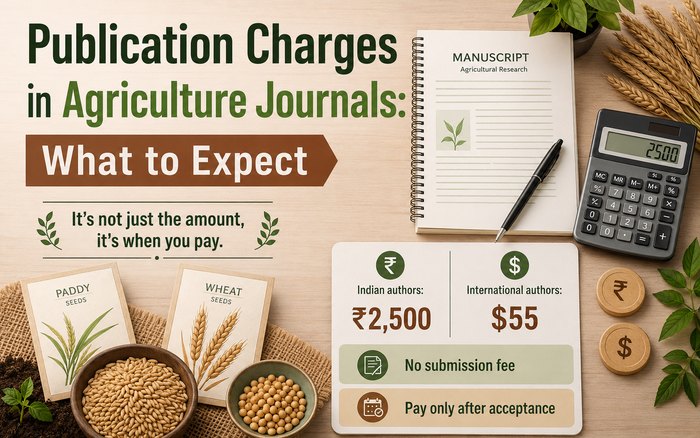
At this agriculture journal there is no submission fee, and an article handling and processing charge of 2,500 INR for Indian authors or 55 USD for international authors falls due only after a paper has been accepted. Across the field charges vary enormously, and what matters as much as the amount is when it becomes payable.
Charges make authors uncomfortable, and the discomfort is usually about not knowing what is normal. This sets out what the money is for, when it should fall, and what should worry you.
| Amount | When | |
|---|---|---|
| Submission | Nothing | — |
| Indian authors | 2,500 INR | After acceptance |
| International authors | 55 USD | After acceptance |
| Reading an article | Nothing | — |
Both rates have been in effect since 1 October 2022 and are stated on the Instructions to Author page, where you can read them before deciding to submit.
Somebody pays for publishing. In a subscription model it is the reader’s library; in an open access model it is the author or their funder. The work being paid for does not change:
This journal receives no governmental or non-governmental financial support, which is why the charge exists. A journal subsidised by a society or a university can charge less or nothing — that is a funding difference, not a quality one.
A charge that falls after peer review cannot have influenced the review decision. A charge that falls before review has been collected by people who had not yet judged your paper.
This is the single most useful thing to check about any agriculture journal’s charges, and it is usually answerable in one line on their site:
| When the charge falls | What it means |
|---|---|
| After acceptance | Normal. The decision was made independently of payment |
| On submission | You are paying to be considered. Ask what for |
| Not stated anywhere | The most serious signal of the three |
| Revealed only after acceptance | You are negotiating from the weakest possible position |
That last row is the trap. By the time you know the number, you have invested months and the paper is accepted — walking away feels impossible. Find the figure before you submit.
| Term | What it usually means |
|---|---|
| Article Processing Charge (APC) | The commonest term for the post-acceptance charge |
| Article Handling Charge | The same thing; used on this journal |
| Submission Fee | A charge to be considered. Different, and rarer |
| Page Charges | Per-page, so the total depends on length |
| Colour Charges | Extra for colour figures in print |
| Subscription price | What a library pays for print copies — not an author charge |
When comparing two agriculture journals, work out the total you would actually pay. A low headline APC with per-page and colour charges on top can exceed a higher flat fee, and the difference only becomes visible after acceptance.
Some journals genuinely charge nothing, and they fall into two very different groups.
A society, university or government body covers the costs. Legitimate and often excellent — and you can usually tell, because the funding body is named openly on the site.
No review to organise, no DOIs to register, no screening to run, no archive to maintain — so no costs to cover. The absence of a charge is not generosity here; it is a description of the service.
The distinction is easy to check. Look for the review process, the DOIs and the indexing, as in our guide to what makes a good agriculture journal. A free journal that passes those checks is a good find. One that fails them is free for a reason.
Send these to the Managing Editor if the site does not answer them. A journal that replies clearly has told you a great deal; one that does not has told you more.
That last question is worth asking explicitly. Here there is no submission fee, so a rejected paper costs you nothing but time.
A hybrid journal is a subscription journal that lets individual authors pay to make their own article open access. The library still pays the subscription; the author pays on top.
Two things to know. The charge is typically several times higher than at a fully open access agriculture journal, because you are buying an exception rather than the normal route. And some funders will not pay hybrid charges at all, on the grounds that the publisher is paid twice for the same content.
The reason the sequence matters so much is worth spelling out. At this journal the reviewers and the Editorial Board reach a decision without knowing what any author will pay, because nothing has been paid at that point.
Where a fee is collected up front, the people deciding know that a rejection returns money and an acceptance keeps it. That does not prove anything about any individual decision, and plenty of journals with submission fees run proper review. But it is a structure worth understanding before you choose, because you cannot inspect it from outside — you can only look at where the money sits relative to the decision.
Charges are not the uncomfortable part they are made out to be, provided two things are true: you can find the number before you commit, and it falls after the decision. Both are checkable in five minutes on any journal’s own site.
There is no submission fee. An article handling and processing charge falls due only after your paper has passed peer review and been accepted: 2,500 INR for Indian authors and 55 USD for international authors, in effect since 1 October 2022.
After acceptance, never before. A charge falling before review is buying something other than publication, because at that point nobody has judged the paper.
Manuscript formatting, the publication process and website maintenance. The journal receives no governmental or non-governmental financial support, so these costs are met from the charge.
Ask the Managing Editor before submitting rather than after acceptance. Policies differ between journals and the answer is easier to give early.
No. Every article is free to read and download from the day it is published, with no subscription and no registration. The charge is on the publishing side only.
No, and this confuses people. The print subscription price is what a library pays to receive printed copies. It has nothing to do with what an author pays to publish.
What the charge pays for, and who pays in the other model:
Created by Deepa Menon • 09 Aug 2026
P-ISSN: 2664-844X
E-ISSN: 2664-8458

International Journal of Agriculture and Food Science