
How to Write an Abstract for an Agriculture Research Paper
Five steps, a word budget that actually fits 300 words, and a worked example — plus the three things this journal will not accept in an abstract.
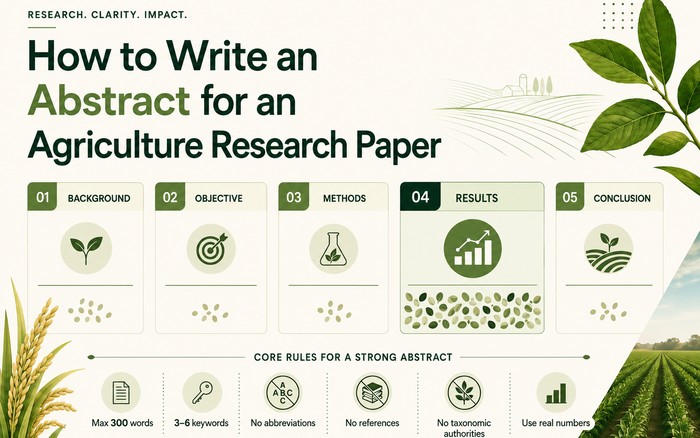
An abstract for an agriculture research paper should be no more than 300 words, contain the gist of the whole study, and carry no abbreviations, no references and no taxonomic authorities. Structure it as background, objective, methods, results and conclusion, give the largest share of words to results, and put real numbers in rather than descriptions of numbers. Follow it with 3 to 6 keywords.
The Rules This Journal Applies
Before technique, the hard limits. The International Journal of Agriculture and Food Science requires that an abstract:
- is not more than 300 words
- contains the entire work’s gist
- uses no abbreviated forms
- uses no references
- uses no taxonomic authorities
- is followed by 3 to 6 keywords
These are not stylistic preferences — a manuscript that breaks them is sent back before it reaches a reviewer. The full specification is on the Instructions to Author page.
Step 1. Write it last, from the finished paper
In an agriculture journal paper the abstract is the last thing to write, not the first. Every sentence in it should already exist, in longer form, somewhere in your manuscript. If you find yourself writing something in the abstract that appears nowhere else in the paper, that is a sign the paper is incomplete, not the abstract.
The practical method: open the finished manuscript, pull one sentence from the Introduction, one or two from Materials and Methods, the two or three most important numbers from Results, and one from the Conclusion. Then tighten. That draft will already be close to the right length.
Step 2. Give each part its share of the 300 words
An abstract that runs out of room almost always spent too much on background. A workable budget for a 300-word limit:
| Part | Words | What it must answer |
|---|---|---|
| Background | 30–50 | Why does this problem matter, and what is unresolved? |
| Objective | 20–30 | What exactly did this study set out to test? |
| Methods | 50–70 | Where, when, on what, how many, using what design? |
| Results | 80–120 | The actual numbers, with units and significance |
| Conclusion | 30–50 | What should a reader now do differently? |
Results deserve the largest share. This is the part a reader cannot get anywhere else, and it is the part most abstracts shortchange.
Step 3. Put real numbers in, not descriptions of numbers
This is the single change that most improves an agriculture abstract. Compare:
“Grain yield increased significantly in the treated plots compared with the control.”
“Grain yield rose from 3.42 to 4.18 t ha-1 (22.2%) under the 120 kg N ha-1 treatment (p < 0.01).”
The second sentence is barely longer and carries the entire finding. It is also what a database, a citation, or an AI assistant will actually be able to quote. Give the treatment level, the effect size, the unit and the significance.
Follow the journal’s unit conventions here too: SI units, a space between number and symbol (10 mg, not 10mg), a zero before the decimal point (0.01), and species names in italics.
Step 4. Say where and when the study was done
Agriculture journal readers judge work by where it was done in a way many disciplines do not. A response measured in a semi-arid Vertisol over two kharif seasons will not transfer to an irrigated alluvial plain, and readers know it. An abstract that omits the site, soil type and season is far less useful, and far less likely to be cited by anyone working in a comparable environment.
Include: the location or agro-climatic zone, the years or seasons, the crop or species and variety, the design, and the number of replications. That is usually two sentences.
Step 5. Cut everything that is not load-bearing
Phrases that can almost always be deleted without loss:
- “It is well known that…” — if it is well known, it does not need saying
- “The present study was undertaken to…” — “This study tested…” says it in four words
- “Various parameters were studied” — name them or drop the sentence
- “The results are discussed” — the reader assumes this
- “Further research is needed” — true of everything; say what research if it matters
Then read the abstract aloud. Anything you stumble over is a sentence a reviewer will stumble over too.
A Worked Example Under 300 Words
The abstract below is illustrative — the figures are invented to demonstrate structure, not taken from a published study. It runs to just over 200 words — well inside the limit — and covers all five parts.
Nitrogen use efficiency in irrigated wheat remains low across the Indo-Gangetic plain, and split application schedules are widely recommended but seldom compared under farmer field conditions. This study tested whether a three-way nitrogen split improves grain yield and nitrogen recovery over the conventional two-way split. A field experiment was conducted over two rabi seasons at a sandy loam site in Ludhiana, Punjab, using a randomised block design with four replications. Wheat variety HD 3086 received 120 kilograms of nitrogen per hectare under three schedules: a single basal dose, a two-way split at sowing and first irrigation, and a three-way split at sowing, first irrigation and boot stage. Grain yield under the three-way split averaged 5.24 tonnes per hectare, against 4.78 under the two-way split and 4.11 under the single basal dose, a gain of 9.6 per cent over the two-way split (p < 0.05). Apparent nitrogen recovery rose from 41.3 to 48.7 per cent. Thousand-grain weight differed by less than 2 per cent across treatments, indicating that the yield response came through grain number rather than grain size. Splitting nitrogen a third time at boot stage raised both yield and nitrogen recovery without additional fertiliser, and is recommended for irrigated wheat on light-textured soils in this zone. Results should be confirmed on heavier soils before wider extension.
Note what it does: names the location, soil, variety, seasons, design and replications; gives three yields with units; reports significance; explains the mechanism in one sentence; states a recommendation; and marks its own limit. No abbreviation, no citation, no taxonomic authority.
Choosing 3 to 6 Keywords
Keywords are how your agriculture journal paper is found by people who have never heard of it. Two rules make them work:
- Do not repeat your title. Search systems already index the title. Keywords are a second chance to be found, so spend them on terms the title does not contain.
- Cover the four axes a reader searches on — the crop or species, the treatment or input, the outcome measured, and the region or system. For the example above that would give: nitrogen use efficiency, split application, wheat, grain yield, Indo-Gangetic plain.
In an agriculture journal, avoid single generic words such as “agriculture” or “yield” on their own. They match millions of records and distinguish nothing.
The Checklist Before You Submit
- Word count is 300 or under — check it, do not estimate it
- Every abbreviation has been written out in full
- No citation numbers or author-year references remain
- No taxonomic authorities after species names
- At least two real numbers with units appear in the results sentences
- The location and season are stated
- 3 to 6 keywords follow, none of them repeating the title
- The abstract makes sense read on its own, with the paper closed
Frequently Asked Questions
How long should an abstract be for an agriculture research paper?
For the International Journal of Agriculture and Food Science the abstract must be not more than 300 words. Many authors write well under that; roughly 200 to 250 words is enough for most field or laboratory studies.
Can I use abbreviations in an abstract?
No. This journal specifically requires that no abbreviated forms be used in the abstract. Write terms out in full, even long ones, and introduce abbreviations later in the main text.
Can I cite references in an abstract?
No. References should not be used in the abstract. If a comparison with earlier work is essential, describe it in words without a citation number, and put the reference in the introduction or discussion instead.
Should taxonomic authorities go in the abstract?
No. Taxonomic authorities should not be used in the abstract. Give the scientific name in italics without the authority, and put the full authority in the Materials and Methods section.
How many keywords should I give?
Between 3 and 6 keywords, placed immediately after the abstract. Choose terms a reader would search for that are not already in your title.
Does a case report need the same kind of abstract?
A case report carries an unstructured abstract, followed by keywords, then Introduction, case report, Discussion, References, Tables and Legends in that order.
Editorial note
Word limits and the restrictions on abbreviations, references and taxonomic authorities are those published on this journal’s Instructions to Author page. The worked example is illustrative and its figures are invented. See also our guide to publishing a research paper in an agriculture journal.