
- Printed Journal
- Indexed Journal
- Refereed Journal
- Peer Reviewed Journal


P-ISSN: 2664-844X
E-ISSN: 2664-8458

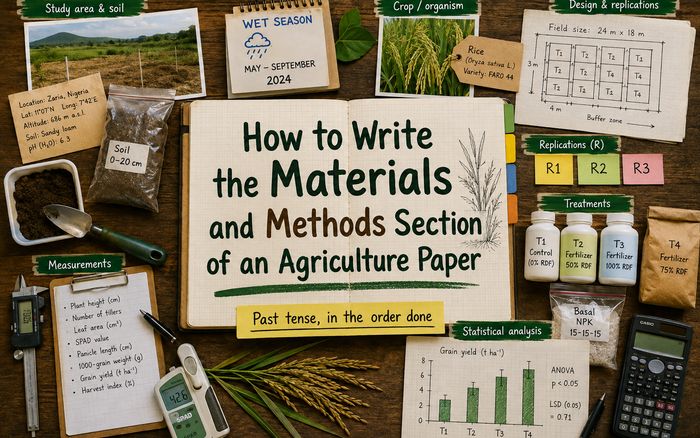
The Materials and Methods section must let a competent reader repeat your work. For agricultural research that means the study area and its soil, the season and year, the crop or organism with its variety or strain, the design, the replications, the treatments, the measurements and the statistical analysis — written in the past tense, in the order the work was done.
This is where most agriculture journal papers are actually lost. Reviewers rarely reject a paper because the result is wrong; they reject it because they cannot tell what was done well enough to judge whether it is right.
Could a competent researcher in my field, with access to a similar site and similar equipment, repeat this experiment from what I have written?
For any agriculture journal, that is the only question. Every sentence either serves it or does not, and the ones that do not can go.
| Element | What to state | Common failure |
|---|---|---|
| Study area | Location, latitude and longitude, elevation, agro-climatic zone | “A field experiment was conducted” — where? |
| Season and year | Kharif or rabi, and the years | Omitted, so the result cannot be placed in time |
| Soil | Texture, pH, organic carbon, available NPK, classification | Assumed to be obvious |
| Weather | Rainfall and temperature over the growing period | Left out, though it often explains the result |
| Material | Crop and variety, or strain, isolate, breed, with source | “Wheat was sown” — which variety? |
| Design | RBD, split plot, factorial — name it, with plot size | “Experiments were conducted” |
| Replications | How many | The most common omission of all |
| Treatments | What was applied, at what rate, when | Rates given without timing |
| Measurements | What was recorded, how, at what stage | Method of measurement unstated |
| Analysis | Test, significance level, software and version | Means reported with no test |
An agriculture journal Methods section following the actual sequence — site, soil, design, treatments, crop management, measurements, analysis — is easier to follow and easier to check. A section organised by theme forces the reader to reconstruct the order, and reviewers who have to reconstruct anything tend to ask for clarification.
Use subheadings where the work has distinct stages. Four short labelled blocks read far better than one long paragraph covering all four.
Here is a Methods paragraph as it usually arrives, and the same paragraph after the missing information is added. Nothing was re-tested between the two.
A field experiment was conducted to study the effect of different nitrogen levels on wheat. The crop was raised with recommended practices and data were analysed statistically.
A field experiment was conducted during the rabi seasons of 2024–25 and 2025–26 at the research farm, Ludhiana, Punjab (30°54′N, 75°48′E, 247 m above mean sea level), in a sandy loam soil (pH 7.8, organic carbon 0.42%, available N 210 kg ha-1). Wheat variety HD 3086 was sown at 100 kg ha-1 in the first week of November in plots of 5 × 4 m. The experiment was laid out in a randomised block design with four replications and three nitrogen schedules: a single basal dose, a two-way split at sowing and first irrigation, and a three-way split at sowing, first irrigation and boot stage, all at 120 kg N ha-1. Grain yield, thousand-grain weight and apparent nitrogen recovery were recorded at harvest. Data were analysed by one-way ANOVA at a 5% significance level using [software, version].
The second version answers every question a reviewer would raise, and it took about twenty minutes because none of it required new work — it was all in the field record.
In an agriculture journal paper, citing an established method saves a page and is the right thing to do. But most methods permit a range of choices, and the reviewer needs to know which you made — sample size, extraction ratio, incubation temperature, the instrument. If you deviated in any way, say so and say why. An unexplained deviation discovered later is far worse than one declared.
The principle is the same but the details differ, and each type is rejected for thin methods just as often as field trials.
State the sample size and how samples were drawn, the extraction or digestion procedure with reagent concentrations, the instrument with its make and model, the calibration standards, and the number of analytical replicates. “Nitrogen was estimated by the Kjeldahl method” is a citation, not a method.
Pot size, growing medium and its composition, number of plants per pot, light and temperature regime, watering schedule, and the number of pots per treatment. Pot studies are frequently reported more thinly than field trials, and reviewers notice.
Sampling frame, sampling method, sample size and how it was arrived at, the period of data collection, the instrument used, and how non-response was handled. A survey with an unstated sampling method cannot be evaluated at all.
For any field study in an agriculture journal, weather over the growing period is not optional context — it is often the explanation for the result. A treatment that worked in a year with well-distributed rainfall and failed in a dry one has told you something, and a reader cannot see that if the rainfall is missing.
Give monthly rainfall and mean maximum and minimum temperature over the crop period, and say where the data came from. Two sentences or a small table. If your result differs between seasons, this is usually where the answer is.
Before it goes to the agriculture journal, give your Materials and Methods to a colleague who did not do the work and ask them to describe the experiment back to you. Not to comment on it — to describe it.
Every point where their description differs from what you actually did is a sentence to rewrite. Fifteen minutes, and it finds the ambiguities you cannot see because you know what you meant and they only know what you wrote. It is the most effective review any paper gets before submission.
Formatting requirements — units, symbols, italics for species names — are on the Instructions to Author page, and our pre-submission checklist covers the rest.
Enough for someone else to repeat the work: the study area, the season and year, the material with its variety or strain, the experimental design, the number of replications, the treatments, the measurements taken, and the statistical analysis with software.
Past tense, because you are describing what was done.
Yes, where it can affect the result — which in most field research it can. Texture, pH and organic carbon at minimum, and the classification if you have it.
Cite it and state anything specific to your use — sample size, dilution, incubation time, any deviation. A citation alone leaves a reviewer unable to judge what you actually did.
If removing a detail would stop someone repeating the work, keep it. If it would not, cut it.
The number of replications. It is one sentence and it generates more reviewer comments than any other missing item.
How figures and tables sit with the surrounding sections:
Created by Kwame Asante • 09 Aug 2026
P-ISSN: 2664-844X
E-ISSN: 2664-8458

International Journal of Agriculture and Food Science