
- Printed Journal
- Indexed Journal
- Refereed Journal
- Peer Reviewed Journal


P-ISSN: 2664-844X
E-ISSN: 2664-8458

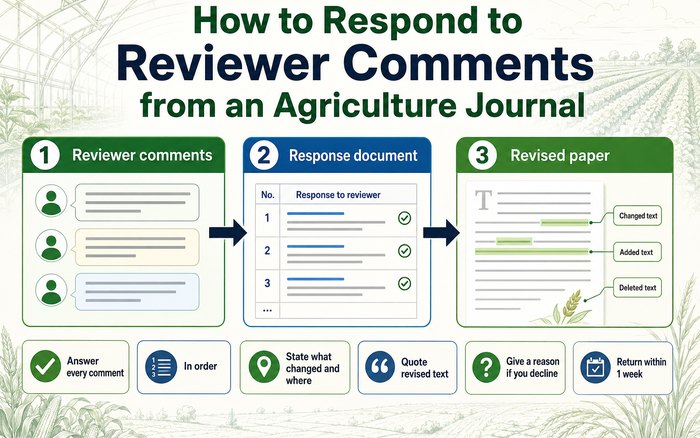
Answer every comment, in order, in a separate response document — including the ones you disagree with. State what you changed and where, quote the revised text, and give a reason whenever you decline a change. At this agriculture journal the revised manuscript is expected back within one week.
This is the stage where publishable agriculture journal papers are most often lost, and almost never because the science was wrong. It is lost because the response was vague, incomplete, or defensive.
The first reading of a critical report is emotional and the reply you draft in that hour should never be sent. Read the comments the day they arrive so you know the scale of the work, then leave them for a day. What looked like an attack usually reads on the second pass as somebody who could not follow your Materials and Methods.
With one week to turn the revision round, that pause has to be short: read on day one, work on days two to five, and keep the last two days for checking rather than writing.
Number every comment and answer it directly underneath. Three elements per response:
Comment 3. The number of replications is not stated.
Response. Added to Section 2.2, page 4. The text now reads: “The experiment was laid out in a randomised block design with four replications per treatment.”
That takes twenty seconds to verify. Compare it with “The manuscript has been revised as suggested”, which tells the editor nothing and forces them to hunt.
Sometimes an agriculture journal reviewer is wrong, or asks for work that is out of scope. Declining is allowed; declining silently is not. The pattern that works has three parts:
Comment 7. The authors should repeat the trial for a third season.
Response. We agree a third season would strengthen the conclusions. The trial site was released for other use after the second rabi season, so the additional data cannot be produced for this revision. We have narrowed the recommendation in Section 4 to the two seasons tested, and added multi-season confirmation to the further work in Section 5.
Nobody got the extra season. The paper still improved, and the reviewer’s concern is now visible in the text rather than buried in correspondence.
| Comment | What it usually means | Typical fix |
|---|---|---|
| “The methodology is unclear” | They cannot repeat what you did | Name the design, the replication count and the plot size |
| “Statistical analysis is inadequate” | Means with no test, or a test with no significance level | State the test, the software and the p value |
| “The novelty is not clear” | Your introduction does not say what gap you fill | One sentence at the end of the introduction |
| “References are outdated” | Too little recent literature engaged with | Add recent work and discuss it, do not just cite it |
| “Conclusions are not supported” | You claimed more than you measured | Narrow the claim to the seasons and sites tested |
| “Figure quality is poor” | Below 300 dpi, or unreadable at print size | Re-export at 75 or 155 mm width, 300 dpi |
Notice how many are reporting problems rather than research problems. Most revisions at an agriculture journal are about writing down what you already did.
It happens more than authors expect, and agriculture journals rarely warn you about it. Reviewer 1 wants the discussion shortened; Reviewer 2 wants it expanded. Reviewer 1 wants a statistical test Reviewer 2 thinks inappropriate for the data.
Do not average them and do not pick one silently. Name the conflict in your response, state which position you followed, and explain why in a sentence or two. Then let the Editorial Board decide — that is precisely what it is there for. An author who spots and flags the contradiction looks careful; one who quietly satisfies one reviewer looks like they did not read the other report.
Sometimes a review is two lines long and says little. Frustrating, but not an invitation to do nothing.
Response to reviewers — Manuscript ID [number]
We thank the reviewers for their comments. Each point is addressed below; changed text is quoted, with the section and page given. All changes are marked in the revised manuscript.
Reviewer 1
1.1 [comment quoted in full]
Response. [what changed, where]. The text now reads: “[revised sentence]”
1.2 [comment quoted in full]
Response. [reason for declining]. We have instead [what you did do], in Section [x].
Reviewer 2
2.1 …
Nothing clever about it. It is verifiable in a couple of minutes, which is exactly what an editor with a queue of manuscripts needs.
| Decision | What the reviewers concluded | What your response must do |
|---|---|---|
| Minor revision | The science stands; clarify and tidy | Show the change, briefly |
| Major revision | Something substantive is unresolved | Answer every point in full |
| Reject and resubmit | Could work, but not in this form | Treat as a new submission, with the reports as a free pre-review |
| Reject | The objection cannot be fixed by rewriting | Fix it before sending anywhere else |
“Major revision” is not a soft rejection, however it feels on the day. It means two independent people read your work and thought it was worth publishing once a real problem was addressed.
The revision goes back to the same reviewers, and the Editorial Board takes the final decision — the process is on the peer review and publication policy page. Our guide on what peer review involves explains what they were asked to assess.
One week at this journal. That is tighter than most authors expect, which is why the revision stage is where papers stall. Read the comments the day they arrive, even if you start work later.
No. You have to answer every comment. Where you disagree, say so and give the reason — a reasoned disagreement is normal and respected. What loses papers is silence.
Say so explicitly in your response, explain which position you followed and why, and let the Editorial Board arbitrate. Quietly satisfying one and ignoring the other does not work.
Yes. A point-by-point response alongside the revised manuscript is what the editor reads. Without it they must compare two versions of your paper to find your changes.
Treat it as a writing problem, not a reading problem. If one careful reader misunderstood a passage, others will too. Fix the passage, then say in your response that you have clarified it.
No. It means the reviewers think the work is worth publishing once a substantive problem is addressed. Papers are lost at this stage through weak responses far more often than through weak results.
The other formatting rules that go with referencing:
Created by Isabel Moreau • 09 Aug 2026
P-ISSN: 2664-844X
E-ISSN: 2664-8458

International Journal of Agriculture and Food Science