
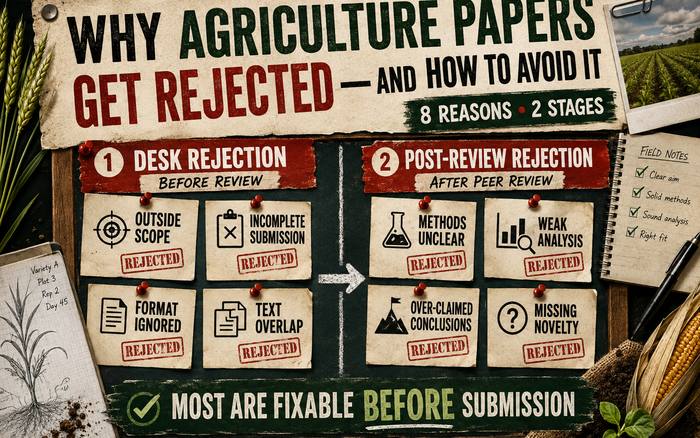
Why Agriculture Papers Get Rejected — and How to Avoid It
Eight reasons manuscripts are turned down, sorted by where in the process they happen — and what each one actually costs to fix.
Most agriculture papers are rejected for reasons that have nothing to do with the quality of the science. Scope mismatches, incomplete submissions, formatting that ignores the specification, and methods described too thinly to be evaluated account for a large share of rejections — and every one of them is fixable before you submit, at no cost.
Two Kinds of Rejection, at Two Different Stages
With any agriculture journal it helps to know which stage rejected you, because the remedy is different.
| Desk rejection | Post-review rejection | |
|---|---|---|
| Who decides | The editor, alone | Subject Editor, on two reviewers’ reports |
| When | Before review | After double-blind review |
| Typical cause | Scope, completeness, format, similarity | Methods, analysis, over-claimed conclusions |
| Cost to fix | Hours — often minutes | Weeks, sometimes more data |
At this journal every proposal is read at least by an editor for an initial review; if it agrees with editorial policies and meets a minimum quality level, it goes to two reviewers for double-blind peer review. Reasons 1 to 4 below sit at the first gate. Reasons 5 to 8 sit at the second.
1. The paper is outside the journal’s scope
The agriculture journal editor’s first job is to check the manuscript against the journal’s editorial policies. A paper on a subject the journal does not cover is returned without review, no matter how good the science is. This costs the author weeks and costs the editor five minutes.
The fix takes fifteen minutes: read the aim and scope, then read the titles in the two most recent issues. If nothing there resembles your topic, you have your answer before you submit.
2. The submission is incomplete
This journal requires three documents together — a cover letter, a signed authorship responsibility form, and the complete manuscript with all figures and tables carrying headings and legends. A submission missing any one of them cannot start the process.
Sample files for all three are downloadable from the Instructions to Author page. Send them together; a manuscript that arrives alone simply sits.
3. The manuscript ignores the format specification
Format is not a matter of taste. The specification here is precise, and every item is checkable in under a minute:
| Requirement | Specification |
|---|---|
| File | MS Word (.doc / .docx) |
| Font and spacing | Times New Roman 12, single line spacing, one column |
| Margins | One inch (2.5 cm) on all sides |
| Length | Research article max 15 pages; review max 4,500 words |
| Abstract | Max 300 words; no abbreviations, references or taxonomic authorities |
| Keywords | 3 to 6 |
| References | Vancouver style, numbered in order of citation |
| Figures | JPG/JPEG, 75 mm or 155 mm wide, 300 dpi |
A manuscript that fails several of these signals that the author did not read the instructions, and an editor reasonably wonders what else was skipped.
4. Text overlap is detected
Every submitted paper is screened with Similarity Check by Crossref. The consequences here are stated plainly: authors found guilty of plagiarism are debarred from publishing in the journal for six months, and a paper found to be plagiarised after publication is retracted under COPE guidelines, with the authors blacklisted.
Two forms of overlap surprise honest authors. The first is self-plagiarism — reusing your own methods paragraph verbatim from an earlier paper. It still registers, and the fix is to cite your earlier paper rather than repeat it. The second is boilerplate — standard descriptions of well-known techniques that everyone words the same way. Rewrite them in your own sentences and cite the original method.
5. The methods cannot be evaluated
This is the commonest reason an agriculture journal paper fails after review rather than before it. A reviewer cannot recommend acceptance for a study they are unable to judge. In agriculture that usually means one of these is missing:
- Replication — the number of replications is not stated, or there are too few to support the claim
- Design — the experimental design is not named, so the analysis cannot be checked against it
- Controls — no untreated control, so the effect has nothing to be measured against
- Statistics — means given without any test, or a test named without the significance level
- Site and season — no location, soil type or year, so the result cannot be placed or repeated
- Material identity — the variety, strain, isolate or source is not specified
None of these require more experiments. They require writing down what you already did.
6. The conclusions run ahead of the results
A reviewer will compare your conclusion against your data, sentence by sentence. Papers get rejected when the gap is too wide:
A single-season trial at one site concludes that a treatment is “recommended for adoption across the region.”
One season, one site, one soil type does not support a regional recommendation, and every agronomist reviewing it knows that. The same study framed as a first-season result that warrants multi-location testing is publishable. The data did not change — the claim did.
The related failure is a Results section that argues. Results state what happened, in the past tense, with no references. Interpretation belongs in the Discussion. Mixing the two makes a reviewer suspect the findings are being oversold.
7. The English obscures the science
Papers are rarely rejected for grammar alone, but they are rejected when a reviewer cannot reliably tell what was done. If two readings of a methods sentence give two different experiments, the reviewer has to guess — and guessing usually resolves against the author.
Before submitting, have a colleague who did not do the work read the Materials and Methods and describe the experiment back to you. Any point where their description differs from yours is a sentence to rewrite.
8. The revision misses its window, or ignores the reviewers
Reviewer comments are sent to the corresponding author, and the revised manuscript is expected back within one week. The revision then goes to the reviewers again, and the Subject Editor takes the final decision. Where substantial revisions were requested, acceptance depends on whether the author has dealt with them satisfactorily.
A revision that silently ignores half the comments is a common way to turn a “major revision” into a rejection. Answer every point, in order, in a covering response — including the ones you disagree with, where you say so and explain why. A reasoned disagreement is respected; silence is not.
If Your Paper Is Rejected
Rejection from an agriculture journal is information, not a verdict on your work. Three things are worth doing, in order:
- Identify which gate you failed. A one-line editorial note usually means desk rejection — scope, format or completeness. Reviewer reports mean the science was read.
- Fix the substantive objections before resubmitting anywhere. The next journal’s reviewers will raise the same points; the reports you already have are a free pre-review.
- Keep the reviewer comments. They are frequently the most detailed reading your paper will ever get, and they improve the next manuscript as much as this one.
And check the target journal properly before the next attempt — scope, indexing, charges and review process. Our guide to publishing a research paper in an agriculture journal sets out what to verify.
Frequently Asked Questions
What is the most common reason an agriculture paper is rejected?
Before review, the commonest causes are that the paper falls outside the journal's scope or that the submission is incomplete or wrongly formatted. After review, the commonest cause is that the methods are described too thinly for a reviewer to evaluate — missing replication, design, controls, statistics or site details.
What is a desk rejection?
A desk rejection is a rejection made by the editor before the paper is sent to reviewers. At this journal the editor first reads every submission and checks it against editorial policies and a minimum quality level; only papers that pass are sent to two reviewers.
Can I resubmit a rejected paper to the same journal?
If the rejection was for scope or formatting, correcting the problem and submitting again is reasonable. If the paper was rejected after peer review on scientific grounds, address the reviewers' substantive objections first — resubmitting an unchanged manuscript will reach the same conclusion.
How long do I get to revise my manuscript?
The revised manuscript should be returned within one week of receiving the reviewer comments. The revision is then sent back to the reviewers before the Subject Editor takes a final decision.
What happens if plagiarism is found after publication?
The paper is retracted, following COPE guidelines, and the authors are blacklisted. Where plagiarism is detected before publication, the guilty authors are debarred from publishing in the journal for six months.
Does a rejection mean my research is not good?
Not necessarily. A large share of rejections are for scope, completeness, formatting or reporting — none of which say anything about the quality of the underlying work. Those are the cheapest problems to fix and the ones most fully under your control.
Editorial note
Process, limits and plagiarism consequences described here are those published on this journal’s Instructions to Author, Publication Policy and Plagiarism Policy pages. No rejection-rate statistics are quoted, as this journal does not publish them. The scientific reasons listed are editorial experience, not measured proportions.