
- Printed Journal
- Indexed Journal
- Refereed Journal
- Peer Reviewed Journal


P-ISSN: 2664-844X
E-ISSN: 2664-8458
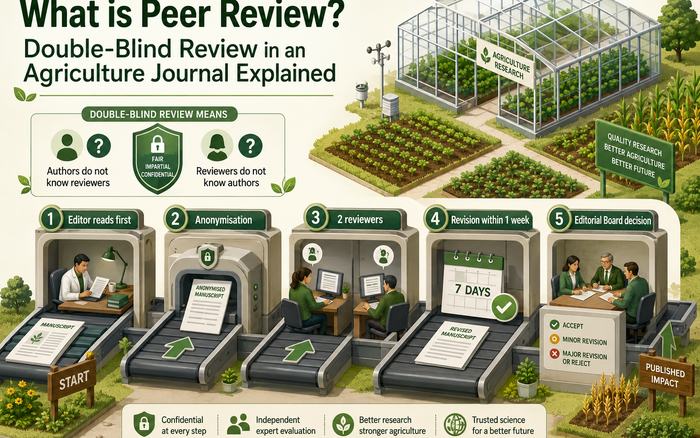
Peer review is the process where independent experts assess a manuscript before an agriculture journal publishes it. In double-blind review the reviewers do not know who wrote the paper and the authors never learn who reviewed it. Here every submission is read by an editor first, then sent to two reviewers, and the Editorial Board takes the final decision on their reports.
Most authors meet agriculture journal peer review for the first time when their own paper is in it, which is a stressful way to learn how it works.
| Model | Author knows reviewer? | Reviewer knows author? |
|---|---|---|
| Single-blind | No | Yes |
| Double-blind (used here) | No | No |
| Open | Yes | Yes |
Double-blind exists to remove a specific problem: reviewers judging a paper by the reputation of the institution on the front page. It is not perfect — a reviewer who knows the field can often guess the group from the methods or the self-citations — but it removes the easiest form of bias, and it protects early-career authors most.
Reviewers at an agriculture journal are not hunting for reasons to reject. They are answering one question: can I tell exactly what was done, and do the results support the conclusion? Almost every negative report traces back to one of these:
None of these need more field work. They need you to write down what you already did.
Double-blind only works if you help. Before submitting, remove your name and affiliation from the body, check the acknowledgements do not identify your institution, and look at the file properties — Word stores the author name in document metadata, which authors forget almost every time.
Self-citation is the other giveaway. “As we showed in our earlier trial [7]” identifies you immediately. Write “an earlier trial [7] showed” instead: same citation, no signature.
Reports vary, but most arrive as a recommendation plus a numbered list of comments. The recommendation is one of four:
| Decision | What it means | What to do |
|---|---|---|
| Accept | Rare on a first submission | Check the proof carefully |
| Minor revision | The science stands; clarify and tidy | Usually a few days of work |
| Major revision | Something substantive is unresolved | Answer every point; this is not a rejection |
| Reject | The objection cannot be fixed by rewriting | Read which stage rejected you |
“Major revision” frightens authors more than it should. It means two independent people thought the work was worth publishing once a real problem was addressed. Papers are lost at this stage far more often through a weak response than through a weak result — our guide on responding to reviewer comments shows the format that works.
Reviewers are researchers in your field, which is exactly why they were asked. One with a genuine conflict is supposed to decline. The far commoner problem is the opposite — a reviewer who knows the area so well that they assume detail you never wrote down, and then ask for it.
Speed depends on how quickly two busy people reply, not on how carefully they read. A paper can clear review in three weeks because both reviewers happened to be free. What should worry you is a fixed turnaround promised before the manuscript has been seen.
It does not, and cannot. Two people reading a document cannot repeat your trial. Review checks whether the work is reported well enough that someone else could repeat it, and whether the conclusions follow from what you reported. That is narrower than most people assume, and it is why replication still matters after publication.
Two checks happen in parallel with the reviewers’ reading, and either can stop a paper on its own:
Every minute a reviewer spends working out what you meant is a minute not spent on your findings, and confusion resolves against the author. Four habits do most of the work:
Two things get said about peer review and both are wrong. It is not a guarantee of correctness — two people reading a manuscript cannot repeat your field trial, and errors do get through. It is also not a rubber stamp: a journal that publishes whatever arrives is not running review at all, whatever its website says.
What to check before submitting anywhere is whether the process is described. This agriculture journal sets it out on the peer review and publication policy page: initial editorial read, two reviewers, double-blind, Editorial Board decides. A journal that cannot describe its own process in a paragraph is telling you something.
Neither side knows who the other is. Identifying information is stripped from the manuscript before it goes to reviewers, and their identities are never disclosed to you. The paper is judged on what it says, not on where it came from.
Two. Before that, an editor reads every submission once to check it agrees with editorial policy and meets a minimum quality level. Papers that fail that check never reach reviewers.
You may name two potential reviewers in your cover letter, with their contact details and affiliation. It is optional and the editor is not obliged to use them. Naming your supervisor or a co-author wastes the opportunity.
Whether the work is original, whether the method is described well enough to be evaluated and repeated, whether the results support the conclusions, and whether the reporting is complete.
The Editorial Board, based on the reviewers' reports. Where substantial revisions are proposed, acceptance depends on whether you have dealt with them satisfactorily.
One week. Read the comments the day they arrive even if you begin work later — the reading takes an hour and tells you the size of the job.
How to remove the avoidable rejections before you submit:
Created by Sunita Rao • 09 Aug 2026
P-ISSN: 2664-844X
E-ISSN: 2664-8458

International Journal of Agriculture and Food Science