
- Printed Journal
- Indexed Journal
- Refereed Journal
- Peer Reviewed Journal


P-ISSN: 2664-844X
E-ISSN: 2664-8458
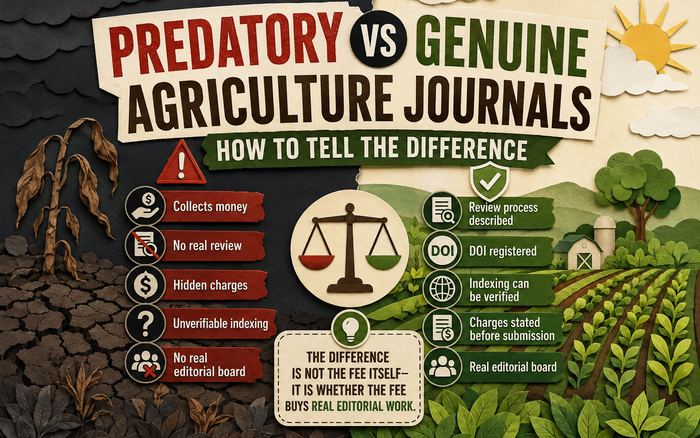
The difference between a predatory and a genuine agriculture journal is not the fee — it is whether the fee buys anything. A genuine journal describes its review process and follows it, registers DOIs, lists indexing you can verify, states charges before you submit, and names a real editorial board. A predatory one collects the money and skips the work.
Nobody submits to a journal they believe is predatory. People submit because the site looked professional, the email was flattering, and the checks that would have settled it take half an hour that nobody told them to spend.
| Check | Genuine | Warning sign |
|---|---|---|
| Review process | Described specifically: how many reviewers, blinded how, who decides | Adjectives only, or no page at all |
| DOIs | Every article has one and it resolves | No DOIs, or one that does not open |
| Indexing | Links to each database so you can check | Logos with no links |
| Charges | Amount and stage, visible before submission | Not stated, or revealed after acceptance |
| Editorial board | Real names, affiliations, a contact route | No affiliations, or no contact |
| Archive | Complete, and old articles still open | Gaps, or dead links |
| Metrics | Named source you can verify | “Impact factor” from a body you cannot find |
Any one can have an innocent explanation. Three together is a pattern, and you should stop.
The email is usually the first contact and the easiest thing to assess, because the same template circulates widely. Four features that appear together:
One of these is a badly written email. All four in one message is a template sent to thousands of people.
This deserves its own section because it works so well. Several organisations sell official-sounding metrics — names close enough to the Clarivate Journal Impact Factor that a busy reader will not distinguish them, awarded for a fee, with methods that are not published.
The test is one question: who calculated this number, and where is the method? A figure appearing only on the journal’s own homepage, credited to an organisation you cannot find independently, is decoration. Our guide on what an impact factor measures explains what the real metric counts, and how a NAAS score differs from it.
On an agriculture journal homepage a row of database logos is an image file. It costs nothing to put one there and no system prevents it.
The check is to open the database and search by name or ISSN. Two failures show up: journals listing databases they were never in, and journals still displaying a logo for a database that dropped them. Neither is visible from the badge, and the second catches even careful authors.
This is why our Indexing Information page gives a direct link for each entry rather than a picture.
One caution, because the checks can be applied too harshly. A small or young agriculture journal is not a predatory one. It may have a short archive, few indexing entries and a modest board, and still run proper double-blind review, register DOIs and state its charges openly.
Judge the process, not the size. The question is never “is this journal famous?” but “does it do what a journal does, and can I verify that from here?”
An email arrives inviting you to submit. Here is the sequence, and where most people stop.
Most problem journals fail at step 2 or step 4, which is why the order matters. You rarely need all thirty minutes.
| Where you are | What you can do |
|---|---|
| Not yet submitted | Simple. Do not submit |
| Submitted, no decision | Withdraw in writing, keep a copy, wait for confirmation before submitting elsewhere |
| Accepted, not yet paid | You are not obliged to proceed. Withdraw in writing before payment |
| Published | You cannot usually undo it, and republishing elsewhere is duplicate publication |
The third row is where people feel most trapped, because months of work sit behind them. It is worth being blunt: paying for publication in a venue you no longer trust adds a line to your record that you may spend longer explaining than the paper is worth.
People often ask for a blacklist. Published lists exist, but relying on one has two problems: new titles appear faster than any list is maintained, and a genuine journal can be listed by mistake with no realistic route to removal.
The checks are better than any list because they work on a journal nobody has assessed yet. A title too new to appear anywhere can still be evaluated in half an hour by the seven questions above — and so can a well-known one that has quietly changed hands.
Predatory publishing persists because it exploits real pressure rather than ignorance. Authors have deadlines, promotion criteria and project reports with dates attached. An email offering fast publication arrives at exactly the wrong moment, and the checks that would settle it feel like a delay you cannot afford.
The half hour is the delay you can afford. What you cannot afford is three months, a fee, and a publication you later have to explain.
A publication that takes a fee and provides little or none of what a journal is supposed to provide — no real peer review, no editing, no archiving, often no genuine indexing. The defining feature is the gap between what is charged for and what is delivered.
Run the checks rather than rely on a feeling: is the review process described, do DOIs resolve, can the indexing be verified in the databases themselves, are charges stated before submission, and is the editorial board real and contactable.
Not on its own, but read it carefully. Flattery about a paper you have not written, a guaranteed turnaround, an unnamed impact factor and a deadline in one email is a mass mailing.
Neither is an assessment of how the journal operates now. Both are useful because the records are public and you can check them yourself — but they do not tell you whether peer review happens.
You cannot usually withdraw a published paper, and republishing it elsewhere would be duplicate publication. Learn the checks, apply them next time, and be careful about listing the paper where verification matters.
No. Charging is a normal open access model. What matters is whether the charge is stated before submission, falls after acceptance, and buys something you can verify.
How to check a journal yourself:
Created by Farhan Siddiqui • 09 Aug 2026
P-ISSN: 2664-844X
E-ISSN: 2664-8458

International Journal of Agriculture and Food Science